Showing posts with label scans. Show all posts

Friday, 15 November 2019

catalog


I recently bought a whole stash of gear from someone (thanks for the tip-off Neil!) and amongst all the user manuals was a collection of Roland brochures from the 70s and 80s. So I have scanned all the synth-related pages from them, and put them into a PDF for the whole world to see. Below the embedded document are some pics of my favourite pages. ENJOY!


Friday, 24 November 2017

Manual Box


I have made a high resolution scan of the Buchla 100 Music Box user manual, as I realised that the only one available online was a copy of a xerox of a copy of a dog-eared copy. Enjoy!

pdf document: Buchla 100 User Manual 2017.pdf

Thursday, 20 August 2015

Cooking 2


Here are some facts about the AS-1 sequencer:

1] Its V.cute


2] It is very small and compact having 16 steps and a lot of nice control features

3] My model has the serial number "DEMO" - so I guess this was one of the first units produced and used by the guys at Polyfusion to show people what it could do


4] The AS-1 was one of the first stand alone step sequencers. I can only think of a few dating from the 1970s: the ARP 1601, the Oberheim Mini Sequencer and the Korg SQ10. The Polyfusion is the coolest looking though. For some reason it reminds me of K9 which is a nice thought

5] The AS-1 came with an amazing user manual that has to be one of the BEST LOOKING USER MANUALS EVER DESIGNED! Its so cool that I scanned my version and made a PDF for you

Saturday, 20 September 2014

Moors Music


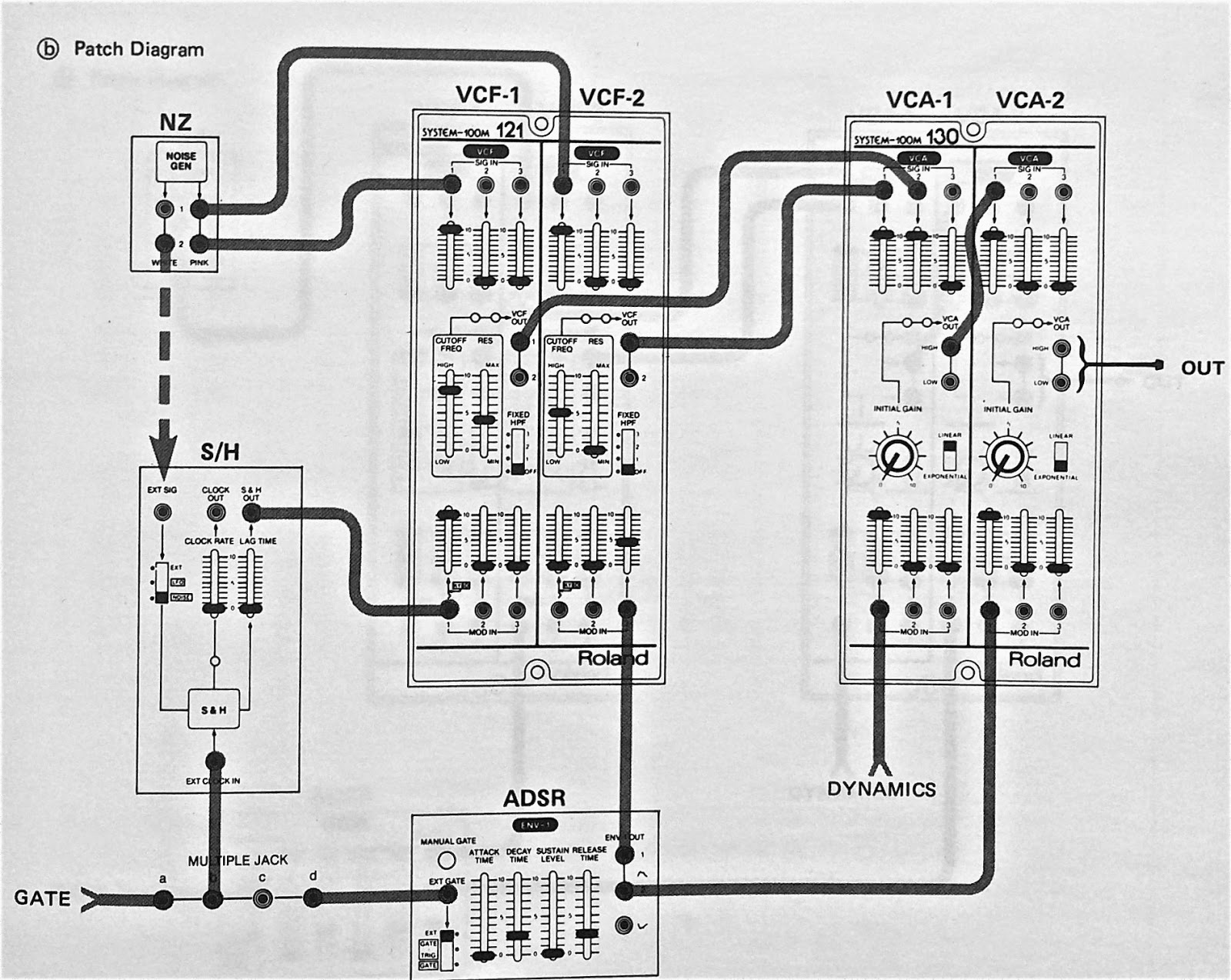
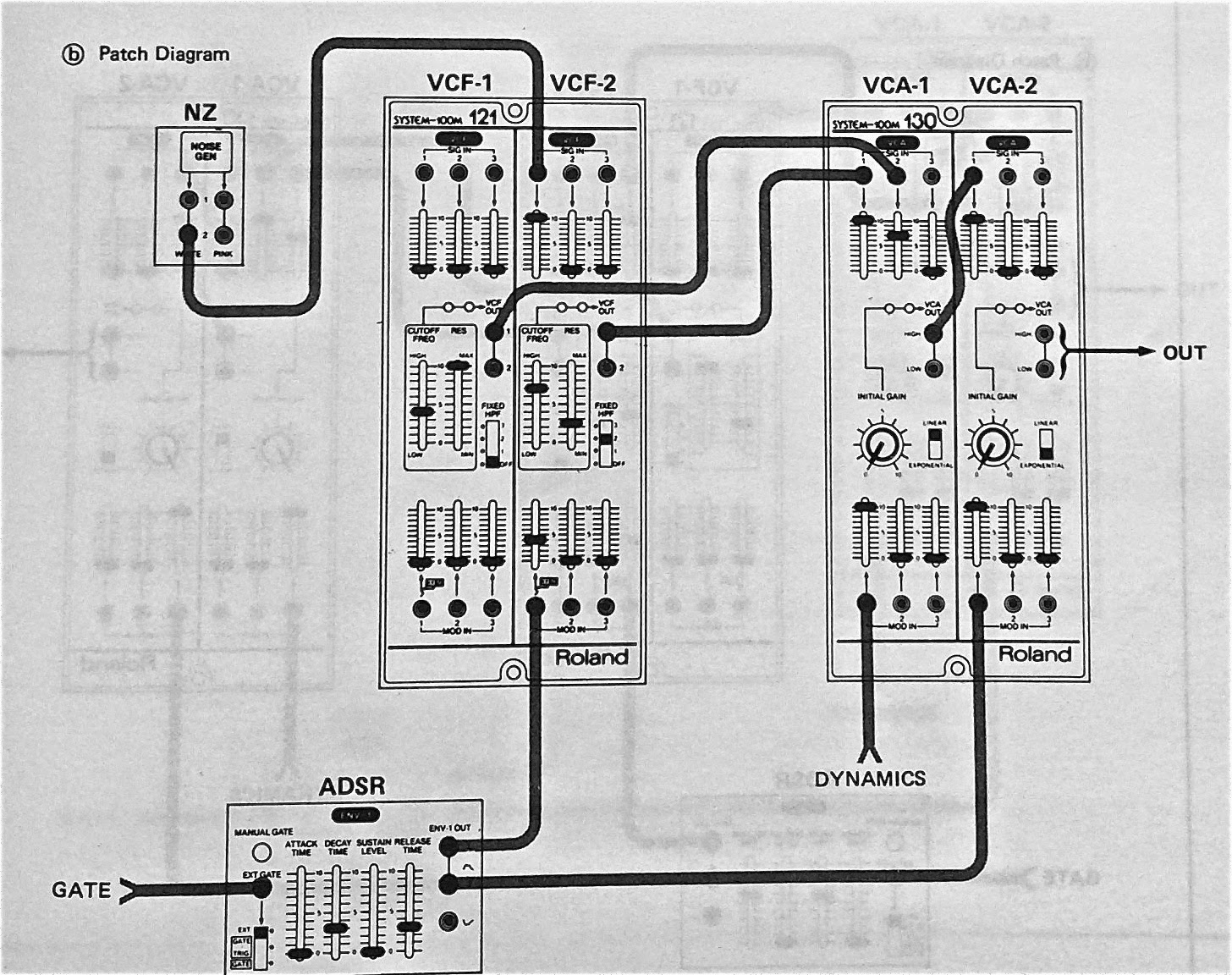
When we were filming the Zombies 85 film Maf shot some footage of me driving up on the moors. So I have set a bit of it to music, all composed on the Roland 100M modular. The sounds were set up using a miraculous set of books called The Synthesizer made by Roland to accompany the System 100M - see below

CLAP
SNARE
BASS DRUM
TOM TOM
CYMBAL

Tuesday, 16 October 2012

Pamphlets


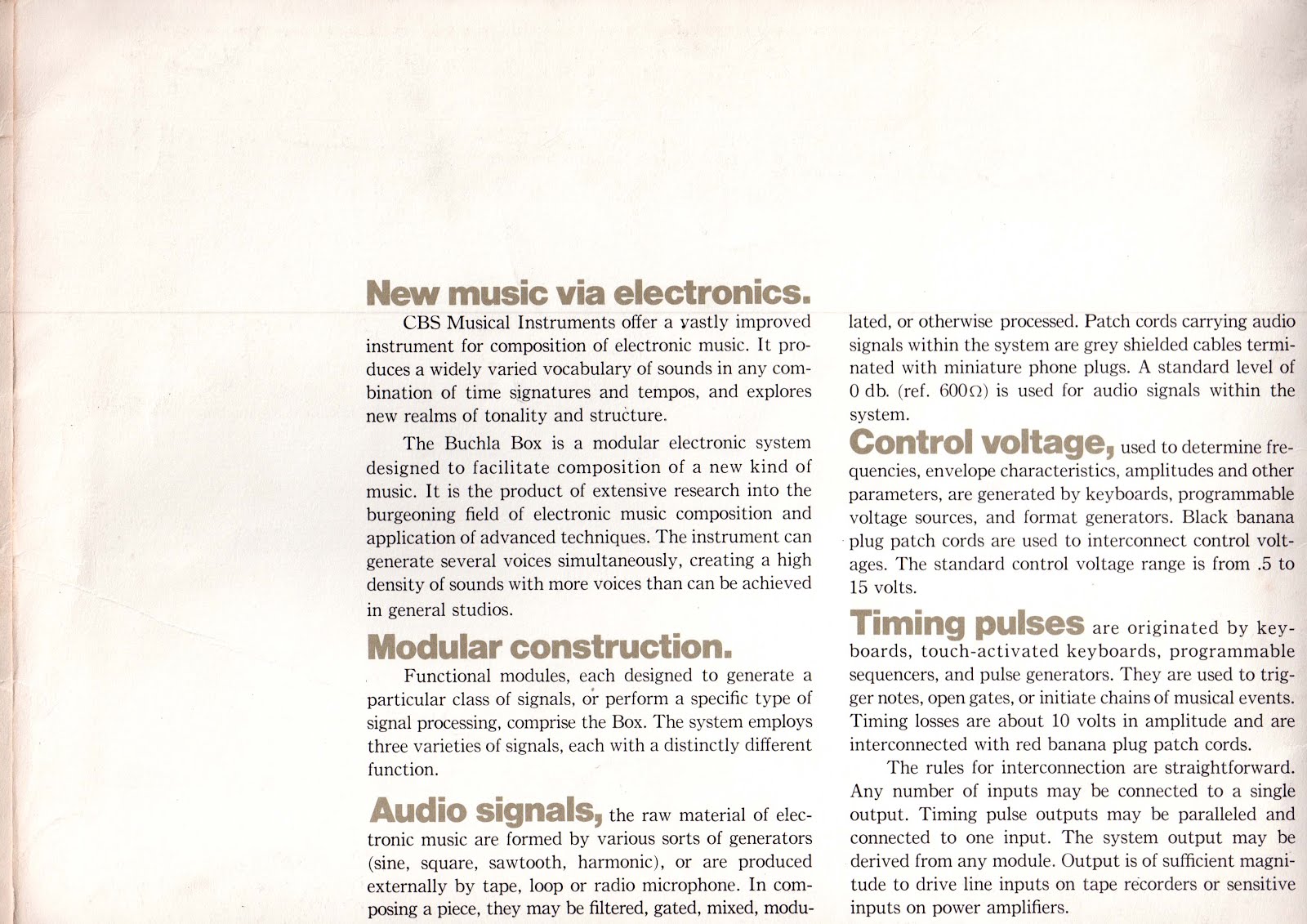
Look what arrived in the post today - some beautiful original Buchla pamphlets! They came in a really nicely designed envelope thing and inside was an original 100 series user manual (I only scanned the cover here because it is already online somewhere - though not scanned very well, so I might scan mine at some point), and a pamphlet about electronic music written by Hubert S. Howe. Also inside were some typed documents explaining all the modules, and these are what the info on the Buchla historical website is taken from. I have scanned in the price list from 1969 which is quite an interesting read. Finally there are two A3 size patch sheets with a big brown stain on them

Monday, 10 September 2012

Krell Meme...


So following on from this post, I was digging around on Muffs and saw that the meme had evolved again. Slipperysoles had posted another self-generating Buchla patch, this time based on an idea from Douglas Leedy in 1970. Leedy made an album called Entropical Paradise which explored automata in music, which is documented in the indispensable book Electronic Music by Allen Strange. See the scan I made of the flow chart of Leedy's original patch. I decided to try and recreate the this on my 200e system, which is itself a evolution of the Buchla 100 Leedy used. There are lots of differences in the modules and functions I had to contend with but I got somewhere close, and as always with the Buchla found something unique along the way


Monday, 30 August 2010

Wednesday, 21 April 2010

Modular Tables

I like doing price comparisons and lists and things, especially when I combine lists and synths. I found this modular synthesizer feature comparison chart from a matrixsynth post a few weeks ago [click to a post he did about a load of cool synth scans by jimmy now lives in sun city]


Here is a link to lots of very interesting original price lists put together by Synthfool. Remember that shops and dealers would usually discount the list prices by 25 - 50%. Inflation means that you generally double prices every 10 years

Below is a current comparison I did [in £] of equivalents to these Buchla 100 systems. Not all the modules are available so I have tried to get close. Gaps are because modules are already covered. As far as the 100 goes, I tried to guess prices first....

Monday, 15 March 2010

Juno 60 Review

Here is a review of the Roland Juno 6 / 60 from this issue of Polyphony magazine, and I plan to put up more reviews as and when I scan them. Its kind of interesting reading reviews written when the instruments actually came out. Written by Eric Meyer in 1983


The Roland Juno-6 was the first of the under $2000 polyphonic synthesizers. It has a five octave keyboard with a good, fast action; and while the actual tone generating apparatus is rather sparse (thus contributing towards the low price), clever design on the part of Roland's engineers has compensated for much of what is missing.

The secret to the Juno's good sound is the Digital Controlled Oscillator (DCO), which produces three simultaneous outputs: variable pulse, sawtooth, and subpulse (a square wave one octave lower than the note actually being played). These three waveforms can be combined in any combination; but there is no mixer and only the sub-pulse, along with an additional white noise source, have amount controls.

While each of the six voices has only one oscillator, the subpulse helps fill out the sound, as does a built-in chorus effect (with two intensities). However, the chorus produces faint white noise sweeps which are audible when the keyboard is not being played, so judicious use is advised. Also, because there is only one sawtooth wave, "brassy" sounds seem rather thin. All waves are, of course, in phase; there is no detune.

The Juno has both a high and low pass filter, which when combined give a bandpass response. The filter can be made to oscillate, thus providing another tone source. There is only one envelope generator (ADSR), shared by the VCF and VCA. The envelope contour of the VCF may be inverted and can also be used to modulate the pulse width in the DCO.

A low frequency triangle wave oscillator provides the only other source of modulation. The range, however, is wide enough (0.3 Hz to 20 Hz) to produce useful effects. Modulation can be routed to the DCO frequency, pulse width, or VCF cutoff frequency; there are separate amount knobs for each. There is also a delay slider, which causes the modulation to fade in over an adjustable period of time after a note has been played. However, a note must be released before playing the next for the delay to be retriggered, as there is only one LFO for all six voices; otherwise, the modulation will continue as normal, with no fade-in. The LFO can be triggered automatically, or by a touch pad to the left of the keyboard.

Also left of the keyboard is an octave transpose for switching the entire keyboard up or down an octave. Most patches do not hold up well in the lowest octave. The bender is center-sprung (sometimes it would be nice if this could be defeated) and can bend the pitch up or down, and/or open and close the VCF. I found it easier to use than the standard pitch wheel configuration.

The arpeggiator will play up or up/down, and will arpeggiate over one, two or three octaves. A hold button will memorize notes, chords or an arpeggiator pattern, and a transpose button allows you to use key of C fingerings in any key. Jacks are provided for a VCF pedal, hold footswitch, arpeggiator sync, headphones and stereo output.

The Juno-60 is basically a Juno-6 with a built-in computer. It can store 56 patch programs and communicate with other Junos or computers. While the Juno-6 (or 60) is not as versatile as the more costly performance-oriented synthesizers, it is a well made, quality instrument. It is especially suited to those needing an inexpensive addition to a keyboard stack, or for people who want to learn about synthesizer basics. The panel layout is clear, and patches can be created quickly and easily (making it useful in a studio environment). The sound is definitely of professional quality. Several other manufacturers have produced synthesizers in the same price range, but I have yet to play one which significantly surpasses the Juno-6. The Juno-6 lists for $1295, the Juno-60 for $1750. You may obtain more information on these and other Roland keyboards by sending $2 to RolandCorp, 2401 Saybrook Ave., Los Angeles, CA 90040.

Wednesday, 30 December 2009

Synapse Magazines


Where can you find interviews with all your favorite synthesists and producers, reviews of recent equipment like the Yamaha CS80 and Polymoog and discussions with all the top manufacturers such as Bob Moog and Cameron Jones from NED? Here. Now you have no excuse to put off building that Seven Stage Frequency Divider